Showing posts with label Piano Profiles. Show all posts

Wednesday, June 23, 2010

Chickering Upright


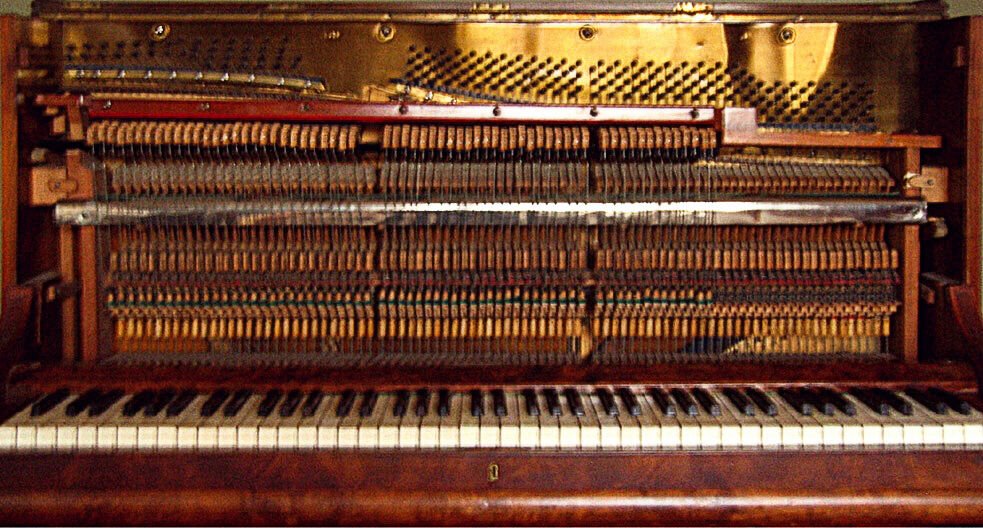
This venerable Chickering upright was built in Boston around 1895, a year before George Chickering died.  George had dragged his heels on making the effort to modernize his production, but this upright seems on a par with its contemporaries.  This is a classic cabinet grand, big, handsome, and still going strong.


Saturday, May 22, 2010

Cool Console #4 - Wurlitzer #2


Either you will think this is very cool, or you won't.  You can't knock Wurlitzer for not trying different styles!  This spinet was built in 1939 in DeKalb, Illinois, a mere four years after the console revolution, and it shows just how quickly some manufacturers caught on to that spirit of revolution.

The parts of the case where wood can be seen are made of cherry, stained brown rather than the usual red.  The rest of the case is covered in cream-colored vinyl, lightly stippled, which has darkened over time.  The keybed emerges like an appendage from the dominant vertical box, making the legs almost unnecessary.  The angled front, which serves as a music desk, is actually part of the lid, which is not hinged - after unscrewing, one simply lifts it off.  My favorite parts are the roll-top fallboard, the faux lyre, and the decorative brass-plated ferrules at the top of the legs.

Compare this Wurlitzer to the one I wrote about earlier.

Related website:
A short history of the Wurlitzer Company.

Saturday, May 15, 2010

1878 Chickering Grand


This Chickering concert grand (8' 8") from 1878 belongs to a church that was built in 1852.  I first saw the piano on its side, stored in a dark alcove with other forgotten items.  It had once been the main piano in the sanctuary, but it was considered too old to maintain.  At some point, the small space it occupied was needed, and the church was prepared to "get rid" of the piano.  A member of the congregation campaigned single-handedly to save the piano, and even bring it back to life.  That turned out to be my job, and it was a delight.  The piano was actually in very good condition, and did not require rebuilding, just repair and reconditioning.  It was moved to its current room on the ground floor, and is now getting regular use.

The main feature of this piano is that it is straight-strung.  That is, the bass strings do not cross over the treble strings, but run parallel to them instead.  The bass strings are iron-wound, and sit on their own bridge.  The hammers are also original, as are the ivories and ebonies on the 88 keys.  The case veneer is rosewood, pieced together in four sections.  The piano's tone is lovely, but clearly not modern.  It has little power, but plenty of sustain, except in the upper treble, which is typical for pianos of this age.  I suspect it had much more power back when the soundboard was newer.  It's very rewarding to play.


Thursday, May 13, 2010

Cool Console #3 - Wurlitzer


This is one of my all-time favorite spinet designs.  The Wurlitzer company, originally based in Cincinnati, Ohio, made a zillion different console models, many of them quite imaginative.  Wurlitzer was one of the handful of companies that immediately embraced the new console design concept when it was introduced in the United States in 1935.  This piano was built in DeKalb, Illinois, in about 1943, just as Wurlitzer stopped production during World War II.

As with the Krakauer spinet I wrote about earlier, this design emphasizes the square grand shape, but in a more stylized way.  The vertical box holding the plate and strings is given some shape rather than being hidden, and the fake lyre is just a decorative gesture.  The fallboard is a Wurlitzer classic - it slides out flat over the keys, with the knobs facing up, and then the hinged front swings down to complete the closure.

The veneer is basic mahogany, and I love that light horizontal band of veneer above the keyboard.  It is also mahogany, the veneer quarter-cut to emphasize the vertical grain, and lightly stained to contrast with the case.  All the furniture details are delightful - the band of beading around the keybed, the filigree on the music desk, and, oh, those legs!

Related website:
A short history of the Wurlitzer Company.


Monday, December 21, 2009

Grotrian-Steinweg


I don't get to see very many of these - a Grotrian-Steinweg upright, built in Braunschweig, Germany, in 1927.  This upright came here not too long ago from England.  It is in very good condition, beautiful ivories on the keys, a nice mahogany veneer with a quite dark red stain - it is almost black, like a really dark rosewood.  It has 85 notes.

The tone of this upright is distinct.  It has a nasal quality, but little of the higher frequencies associated with American pianos.  The soundboard has flattened, so there is little power, and the tone tends toward dark and lush. 

If the name after Grotrian seems familiar, that's no coincidence.  Heinrich Steinweg, a German piano maker, came to New York and established a company under his Americanized name, Henry Steinway.  With him were three sons, hence Steinway and Sons.  But another son named Theodore stayed in Germany and continued making pianos there under the original name Steinweg (pronounced "SHTINE-vaygh"), in partnership with Friedrich Grotrian.

Two of Henry's sons died in 1865, so Theodore came to New York to help his father.  Theodore was an amazing piano designer, and he ended up being responsible for many of the Steinway patents that helped the company become what it is today.  Theodore sold his company in Germany to three of his employees, including Wilhelm Grotrian, son of the late Friedrich.  They were allowed to continue using Theodore's name for ten years.  After that, the company started using the brand name Grotrian-Steinweg, and that's when the trouble started.  The lawsuits began in Germany, and ended up in the United States, and were fought off and on for a century.

It was eventually decided by the US courts in 1975 that Grotrian's use of the Steinweg name was a trademark violation, so now Grotrian makes pianos for export to the United States under the single name Grotrian.  They are quite lovely pianos, and are still being made in Braunschweig (which is sometimes rendered in English as Brunswick).

For more on the century of litigation, see Grotrian vs.  Steinway.
By the way, Grotrian has a cute musical game on their website called the Pianolina.

Sunday, December 20, 2009

Bachmann, Berlin


This beautiful Bachmann upright was built in Berlin, Germany.  I can't seem to find any reference to this company anywhere, so I can't say for sure when it was built, even though I know the serial number.  It was probably built in the very early 20th century.

I looked all over the piano for a date.  Sometimes whoever worked on the keyboard will sign their names with a date on the first few keys.  I've even seen the signature of a manufacturer and a date proudly written on the inside of the case.  A hammerhead might carry a date, or the plate might have a date cast into it.  If the piano has been worked on by someone who knows when it was built, he might pencil the date on the plate, or on the keyframe behind the keyslip, or stamp it into some wooden case part.  In addition to serial numbers, there are also case numbers, used as reference in the factory before the serial number has been assigned.  If the action was made by a separate action maker, it could have its own serial number, or a date stamp.  Rebuilders sometimes switch parts from different pianos, creating great uncertainty about when a piano was actually built.  On this piano I found various numbers, but no date, alas.

Bachmann's name is carved into the veneer of the fallboard, something I'd never seen done before.  Usually the maker's name is attached as a decal, or sometimes inlaid.  Another name is carved into the keystop rail, beneath Bachmann's name; Rosen's, apparently a piano dealer in Cape Town, South Africa.

It is a typical German upright with a bird-cage action (like the Berlin-made Waldmann I posted about earlier, also from South Africa), and an over-strung bass section.  The keytops were probably originally ivory, but they have been replaced with ivorine.  The gorgeous veneer is book-matched walnut, with burled walnut panels.  There used to be candelabra attached to the two side panels in front.  The turned balls and collars on the legs are a nice touch.

Bird-cage action!

Monday, August 24, 2009

Cool Console #2 - Kawai


I love this little Kawai console, with its vertical plain-stripe walnut veneer.  The furniture style, called "continental," features no front legs, flat sides, a large, broad bottom board, and a plain front board that angles back to a narrow top.  The lid is hinged in back.  It would be more traditional to have only two pedals, but the American market demands three.  It was built by Kawai in Japan in 1983.  This console model was a very successful model for Kawai, and it is a lovely little instrument.

I had never seen one of these with this kind of veneer before.  Usually vertical stripe veneer is used as an accent on small horizontal elements, not across the entire piano.  It is not everyone's cup of tea, but I think it works adorably with the style.  The stripes come from how the wood is cut to make the veneer.  The cut is called a quarter cut (or the wood is said to be quarter-sawn), which means that the cut is 90 degrees to the grain, along or parallel to the tree's radius.  You can see that it takes five pieces to cover the width of the piano.

Monday, July 6, 2009

Wm Knabe & Co


This lovely grand was built in Baltimore, Maryland, in about 1890.  Knabe (pronounced "k-NAH-bay") was one of America's premier makers, and after the Civil War was considered on a par with Steinway, Chickering, Mason & Hamlin, and Weber.  This piano was made when the company was still run by a Knabe; Ernest, the son of the founder William.

Knabe figured prominently in the formation of the American Piano Company in 1908.  George Foster, a business school grad, had started out as a reed organ salesman, and by 1894, the year Ernest Knabe died, had formed a partnership with William Armstrong to manufacture pianos in Rochester NY.  Their first major acquisition was the Marshall & Wendell Co of Albany in 1898.  Finally, a decade later, after acquiring a number of other companies, they incorporated as American Piano Co.  Knabe was one of the cornerstones of the company; Chickering & Sons, bought in the same year, was the other.

But long before those events, this 7½ foot walnut-veneered grand rolled out of the factory in Baltimore, as would many more until about 1930, when Knabe was moved to the American Piano Company's factory campus in East Rochester.  Pianos with the Knabe name continued to be made in East Rochester for another 50 years.  After a hiatus of passing through various owners, a Knabe line was developed and manufactured in Korea in the late 90's, and finally bought by the Korean maker Samick in 2001.  Samick continues to manufacture pianos with the Knabe name.

A few details about the instrument:  it has 88 notes, two bridges, a pieced (rather than molded) case, and a sloped pinblock not covered by the plate.  The action has wooden brackets, and uses a wooden rocker mechanism rather than the modern threaded brass capstan to regulate the connection between the keys and the wippens.  It has a surprisingly modern tone for a 120-year-old piano.

Tuesday, June 9, 2009

Cool Consoles - Introduction

Every piano manufacturer has been proud of its big pianos - the cabinet grands, the parlor and concert grands, even the square grands back in the day.  But the piano-makers' bread and butter since the 1920's has been the small pianos - the baby grands, and especially the consoles and spinets.  It was in the 20's, as smaller homes and apartments were being built, that the American consumer, especially the American housewife, began to turn away from the big pianos, particularly the tall, boxy upright player pianos that had been so popular.  The newfangled radio, for example, was smaller, and prettier besides.

In response, manufacturers tried to make their uprights less imposing by scaling down and simplifying the design.  But it was still a big brown ugly box.  Even when they started making smaller uprights, about 48" tall, they were nothing more than miniaturized versions of the big uprights.  Fortunately, as upright sales plummeted in the 30's, the baby grands had become very popular, and kept the industry from collapsing altogether during the Depression.

In 1934, the Swedish piano company Lundholm designed a small upright piano that was completely different from the regular uprights.  It was very short, the cabinetry was attractive and not boxy, and the action was redesigned to fit the smaller space.  The Associated Piano Co of London immediately bought the rights to the design and began manufacturing them as Minipianos.  In 1935, the Minipiano was licensed to Hardman, Peck & Co in the United States.  At the same time, both Haddorff and Winter & Co introduced their console pianos, and within months the industry had completely changed.  Baldwin and Wurlitzer introduced their console designs, and every manufacturer joined the race to create as many different furniture styles as possible with the new design.  These minipianos were an instant hit with consumers in spite of their failings as instruments.

The small pianos came to be called spinets.  Historically, spinet was the name for a particular kind of small harpsichord (possibly, but not definitely, after Spinetti, the name of an Italian maker).  It now means a small upright with a drop, or indirect-blow, action.  What this means is that the action is below the level of the keys, and the keys pull up on the wippens to move the hammers.  This is different than a direct-blow action, which sits above the keys, and the keys push the wippens up.

The name console was coined by the French maker Henri Pape in the 1820's to describe his design of a small upright.  This was at a time when uprights were seven or eight feet tall.  So any small upright is a console upright, and spinets can be said to be a kind of console upright.  After the introduction of the spinet in 1935, manufacturers also began making small direct-blow actions in decorative consoles slightly taller than the spinets.  The larger of these console uprights came to be called studio uprights, and the smaller, which employ a compressed version of the action, are now simply called consoles, in a way meant to distinguish them from spinets and studios.  For this series of postings, however, I will use the word console to mean any small console upright, including spinets.

The furniture styles of consoles range from the sublime to the ridiculous, from elaborate reproductions of historic styles to space-age modernism.  I really love them, the more outlandish the better.  As instruments, however, they leave much to be desired.  Studios eventually became serious instruments, but the consoles are really too small to have high-quality sound, especially in the bass.  The bridge design and placement sometimes results in poor tuning stability and sound quality.  The compressed direct-blow actions are not very responsive, and the drop actions require short keys whose leverage is all wrong.  When manufacturers began cutting corners to cut costs, especially in the late 60's and 70's, the consoles with their inherent design compromises and flaws suffered tremendously.  Still, at their best, some of these consoles wound up sounding pretty good, and playing quite adequately.

Wurlitzer, under the Baldwin name, was the last US manufacturer to make spinets, in the mid 1990's.  Consoles, however, are still quite popular, and are actually better made now than they were 20 years ago.  Sadly, the furniture styles have boiled down to a handful of not very inspiring quasi-historical designs.  When I do encounter a cool console, though, I will document it in a posting here.

Monday, June 8, 2009

Cool Console #1 - Krakauer


This lovely spinet is a Krakauer made in 1946.  Krakauer Brothers of New York City was one of the few mid-sized piano companies to avoid being swallowed up by one of the large piano conglomerates in the 1920's and 30's.  It wasn't until 1980 that Kimball took control of the name.

This piano was designed to look less like an upright and more like a small square grand, a common design approach for the time.  The ribbed bowed sides are meant to disrupt the necessary vertical box holding the plate and strings, and draw attention to the flat horizontal box holding the keyboard and action.  The veneer is a lovely walnut, with vertically oriented grain on the keyslip, the stretcher above the fallboard, and the pedal stretcher.  The bottom board has a fake lyre above the pedals.  The medallion above the fallboard has the name Krakauer stamped into ivory-colored celluloid.  The inlaid daggers above the legs are an especially nice touch.

Sunday, May 17, 2009

Steinway Square Grand


Grand pianos come in two shapes:  the familiar wing shape, and a rectangular shape referred to as square.  Square grands are no longer made, which is why you don't see them often, but they were made as often as their wing-shaped cousins for more than half of the piano's 300 years of existence.  If you do see a square grand, it is likely to be pretty old.

This is one of many squares that I have maintained over the years.  It was made by Steinway in 1864, and it is in splendid condition.  It is not quite seven feet across, with a rosewood case, 88 keys, and two pedals.  The left pedal is a moderator pedal; it moves a rail with a thick strip of felt between the hammers and the strings to soften the sound.  It has two bass bridges, a tenor bridge, and a long, tightly curved treble bridge.  The tuning pins have oblong rather than square ends.

The regular wing-shaped grand has its strings more or less parallel with the keys, running from the keyboard back to the tail.  The square grand has its strings more or less transverse to the keys, running from left to right.  The wing shape evolved from the harpsichord.  There were also square harpsichords (called virginals), but the square grand evolved from the rectangular clavichord.  Wing grands stand on three legs, square grands on four.  The lid of a wing grand is hinged on the straight left side, and on a square is hinged along the back.

As did the wing grands, square grands became bigger and bigger over time.  Unlike the wing grands, square grands did not scale up well.  The transverse string pattern had to be fanned out such that the bass strings run left to right, but the extreme treble strings run parallel to the keys.  This requires a similar fanning of the hammerhead angles, key length, and damper felts, making regulation a nightmare.  More and more of the tuning pins were placed at the far back side of the piano, making tuning a nightmare.  Three or more bridges were needed to accomodate the stringing pattern, and the treble bridge developed a tight curve just at the point where the fanned strings all come together, creating a deadly weakness in the bridge.


What people liked about the square grand was that it was less expensive, and fit more easily in a small space - you could tuck it right into a corner.  When upright pianos finally became serious instruments, they took this advantage away from square grands, and by the late 19th century, manufacturers stopped making squares.  Or they wished they could stop making squares, because uprights were more profitable, yet demand for squares lingered.  The manufacturers made a statement:  in 1904, at a professional meeting in Atlantic City, they built a giant bonfire of square grands.  Even at that, I have come across a 1930's square grand made by Mathushek, an attempt at modernizing the square.

Square grands are not common, but they are not rare, either.  Many were made, and there is nothing particularly valuable about them.  You can get them easily for free, so don't get suckered by an antiques dealer.  They do not and will never feel or sound like modern pianos.  It can cost a fortune to fix or rebuild them because nothing about them is standard, everything has to be custom made or jury-rigged, the work is very labor-intensive, and therefore expensive.  Many technicians refuse to go near them.  There will be no return on your investment.

They are sometimes very pretty, always awesome, and make great conversation pieces.  They are often turned into desks and tables.  I've seen the legs turned into pedestals or small side tables.  If a square grand is in good condition, and you can find a willing technician, and can afford the repair, it can be a lovely and satisfying instrument.

Technician tips, click here . . .

Friday, May 8, 2009

Chickering & Sons


Ah, Chickering - at turns eccentric, maddening, brilliant, heart-breaking!  Being a Boston Chickering fan is a lot like being a Boston Red Sox fan.  There's even the rivalry with a New York team named Steinway.  In the great Paris Exhibition of 1867, both Chickering and Steinway claimed top prizes (and fought over who had "won"), but even then, Steinway was in the lead technologically, and never looked back.

It wasn't that Chickering was not innovative.  Their penchant for tinkering was such that it is said that no two Chickerings were made alike.  Their innovations, however, did not often lead to an actual evolution of piano design and manufacture.  When the last Chickering brother passed away, in 1896, their pianos were charming, but obsolete by the time they rolled out the factory door.

The administration of George Chickering had been a disaster for the company, which had had to wait until he died to begin modernizing their designs.  Until the company was finally bought by the American Piano Company, twelve years later, it produced a run of more modern grand pianos.  Some of these "transitional" pianos are a nightmare, some are fantastic, and all are targets of eager rebuilders wanting to restore the glory and beauty of a Chickering grand.  This task has been the undoing of countless technicians who had no idea what they were getting into, and who did not have the skill to deal with the eccentricities and unconventionalities of these old Chickerings.  But the pianos sure are pretty refinished.


In Newport there is a lovely old bed & breakfast called Sanford-Covell Villa Marina.  The owner has her grandmother's and great-grandmother's 6'5" Chickering rosewood grands installed in the Victorian parlor.  The older one was built in 1892, and the other one is a transitional grand from 1903.  The description and close-up photos are of the older piano, on the left.

This grand, made in the waning years of George Chickering's tenure, has a pieced case of four parts:  the left straight side; a broad, curved tail; the curve of the right bent side; and the cheek, or straight portion, of the bent side.  Modern piano cases, in contrast, are made of a continous, molded rim.  The bass bridge is also pieced, in three parts, rather than shaped into a continuous curve (though the cap is continuous).  There is a separate bridge for the tenor section.  There are 88 notes, and all 88 are agraffed, an unusual feature.  Finally, the portion of the plate covering the slanted pinblock is a separate piece on top of which the rest of the plate is bolted.

It would take days to detail the arcana of the action.  It suffices to say that the function of the various parts resembles a modern action, but the specifics of their manufacture and assembly are entirely exotic.

Though apparently vexing for the countless technicians of the past century, this is a sweet, lovable, old-fashioned instrument, somewhat frail and rickety, but still pleasing to play.


Monday, March 30, 2009

Friedr. Ehrbar


This wonderful old grand piano was made in Vienna in about 1892.  It came to the United States not too long ago, and was just recently set up in its new location.

The case is pieced together on the bent side, but molded into its curve at the tail.  The music desk has two candle stands (what I jokingly call beer and sandwich boards) that can be rotated into position on either side of the music rack.  The two pedals, rather than pushing up at their back ends on pedal rods, instead pull down on pedal wires in front of the lyre.  The legs have giant wooden screw threads for attaching to the case body.  The key slip (in front of the keys) drops down for removal rather than lifting up!  There are only 85 notes (typical for the time), but there's an extra bass string at the very bass end, and an extra unison set of treble strings at the other end.

Other than the detailing, this piano seems quite modern in design, until you pull out the action.  The action is much more similar to that of a square grand.  The cheek blocks (on either side of the keyboard) are glued on, and come out with the keyframe.  The keys have a capstan, and there is a wippen, but the wippen and jack face backwards.  There is no repetition lever, and the hammer has a butt, as in a square grand.  The dampers are set up like modern ones.

A century before this piano was built, there was an active school of piano building in Vienna that used a kind of action that came to be called Viennese.  So there is some irony in a Viennese piano having an action much more akin to the English action.

The piano sounds great, not too old-fashioned, and as you can see, it's really beautiful, and beautifully made.  I'm glad I brought my camera!


Sunday, March 22, 2009

A. Waldmann, Berlin

The classic bird-cage action:


This little gem is an old German upright that lived most of its life in Johannesburg, South Africa.  It resembles several old (and not so old!) English uprights that I have seen over the years.  The top action has wooden brackets on either end, and the dampers are carried in a damper action called a bird-cage.  In a bird-cage action, the dampers are above the hammers rather than below, and the dampers are lifted by long wires that run down and attach to the fronts of the wippens.  It is these long parallel wires that give the action its name.  (In a modern upright action, the dampers are below the hammerheads and lifted by metal tabs, called spoons, attached to the backs of the wippens, out of sight.)

Unlike the English uprights, this upright has bass strings that cross over the treble strings, as in modern uprights.  (The English uprights are usually parallel-strung rather than cross-strung.)  As is typical with European pianos, there are only two pedals.  Equally typical is the bookmatched burled-walnut veneer.  Sadly missing from this piano are its original candelabra, which had been attached to the front panels above and on either side of the music desk.

The easiest way to tune a piano with a bird-cage action is to remove the bird-cage.  Take out the screws holding the cage down (usually one at each end) and lift the cage up and out.  Check first to make sure the lift wires are not attached to the wippens - usually they just slip out.  Of course now you have no dampers, and the strings all ring out.  I have found, though, that I get used to this quickly, and can tune without difficulty.  On the lower strings I will use my hand to stop the ringing when it gets excessive.

A full portrait of this pretty little piano:

Friday, February 27, 2009

Steinway & Sons

Another pin-up shot:


This is a classic turn-of-the-(last)-century Steinway upright that I had the privilege of reconditioning many years ago.  The case was refinished and is quite beautiful, but of course I prefer to admire the inner workings.

Wednesday, February 11, 2009

Poole Piano Co

Isn't she beautiful?


I never tire of opening a piano up and gazing upon the action.  Those 88 hammers and wippens, those 230-or-so tuning pins and strings, just make my eyes happy.  My dad said that I was just like him in this regard.  When he was a kid, his mother would give him a handful of pennies to play with, a whole handful of identical objects.  He could play with them all day!

I also love those giant bolts and screws on the plate.  As a kid, I wanted the screwdriver that could fit those giant screws.  My parents wisely kept me away from the screws and focused my attention on playing the keys.  But now I own that screwdriver!  And I still play those keys!  I guess I couldn't be happier.