The middle-of-August heat wave finally convinced us swamp Yankees to turn on our air conditioners. For our pianos, it was too little too late. The heat wave was humid, but not as bad as in June and July.* The difference was that June and July were cool, so no one turned on the AC. Now the pitch on most pianos, even those with humidity control, is quite high, but not evenly so across the keyboard. Most pianos right now are almost comically out of tune. If you can wait, they'll actually sound better later in the season (if it's not too wet an autumn). If you can't wait, and you certainly cannot if you're gearing up for the return to school, your tuner will have a lot of work ahead of him or her.
Expect the pitch to be 15 cents or more high right in the temperament octave. I'd recommend dropping the pitch to about 6 cents high (A441.5). If you have to go to A440, plan on a pitch-lowering before tuning. The pitch might not be quite so high below the temperament octave. The top of the bass section will be about 5 cents high, rising to maybe 10 cents high around C2, then dropping back down, possibly to zero, at C1.
On the treble end, the pitch will actually drop as you approach the tenor/treble break. C5 will be about 5 cents or so high. But don't be fooled, right after the break, you'll be back at 15 cents high. Then the pitch will quickly drop to about 10 cents high or less around C6, where it might stay, or might drop slowly to zero by C8.
You'll have to keep alert about octave 4 and the part of octave 5 above the break - the pitch is going to want to drift up as you're working. Keep your wits about you if you want to be done in a reasonable amount of time. Every piano I've tuned recently has been a struggle. Good luck.
*A quick example: today is a comfortable 70 degrees F with about a 60 degree dewpoint, cloudy with rain approaching. This translates into a relative humidity of 70 percent, which is quite high in spite of how comfortable it feels. If the temperature hit 90, even with a higher dewpoint of 70 (which would feel pretty muggy), that would only be a relative humidity of 50 percent.
Click here for an explanation of humidity (from my website).
Click here for weather calculators at the National Weather Service website.

Showing posts with label Tuning. Show all posts
Showing posts with label Tuning. Show all posts
Friday, August 28, 2009


Sunday, May 17, 2009
Steinway Square Grand

Grand pianos come in two shapes: the familiar wing shape, and a rectangular shape referred to as square. Square grands are no longer made, which is why you don't see them often, but they were made as often as their wing-shaped cousins for more than half of the piano's 300 years of existence. If you do see a square grand, it is likely to be pretty old.
This is one of many squares that I have maintained over the years. It was made by Steinway in 1864, and it is in splendid condition. It is not quite seven feet across, with a rosewood case, 88 keys, and two pedals. The left pedal is a moderator pedal; it moves a rail with a thick strip of felt between the hammers and the strings to soften the sound. It has two bass bridges, a tenor bridge, and a long, tightly curved treble bridge. The tuning pins have oblong rather than square ends.
The regular wing-shaped grand has its strings more or less parallel with the keys, running from the keyboard back to the tail. The square grand has its strings more or less transverse to the keys, running from left to right. The wing shape evolved from the harpsichord. There were also square harpsichords (called virginals), but the square grand evolved from the rectangular clavichord. Wing grands stand on three legs, square grands on four. The lid of a wing grand is hinged on the straight left side, and on a square is hinged along the back.
As did the wing grands, square grands became bigger and bigger over time. Unlike the wing grands, square grands did not scale up well. The transverse string pattern had to be fanned out such that the bass strings run left to right, but the extreme treble strings run parallel to the keys. This requires a similar fanning of the hammerhead angles, key length, and damper felts, making regulation a nightmare. More and more of the tuning pins were placed at the far back side of the piano, making tuning a nightmare. Three or more bridges were needed to accomodate the stringing pattern, and the treble bridge developed a tight curve just at the point where the fanned strings all come together, creating a deadly weakness in the bridge.
What people liked about the square grand was that it was less expensive, and fit more easily in a small space - you could tuck it right into a corner. When upright pianos finally became serious instruments, they took this advantage away from square grands, and by the late 19th century, manufacturers stopped making squares. Or they wished they could stop making squares, because uprights were more profitable, yet demand for squares lingered. The manufacturers made a statement: in 1904, at a professional meeting in Atlantic City, they built a giant bonfire of square grands. Even at that, I have come across a 1930's square grand made by Mathushek, an attempt at modernizing the square.
Square grands are not common, but they are not rare, either. Many were made, and there is nothing particularly valuable about them. You can get them easily for free, so don't get suckered by an antiques dealer. They do not and will never feel or sound like modern pianos. It can cost a fortune to fix or rebuild them because nothing about them is standard, everything has to be custom made or jury-rigged, the work is very labor-intensive, and therefore expensive. Many technicians refuse to go near them. There will be no return on your investment.
They are sometimes very pretty, always awesome, and make great conversation pieces. They are often turned into desks and tables. I've seen the legs turned into pedestals or small side tables. If a square grand is in good condition, and you can find a willing technician, and can afford the repair, it can be a lovely and satisfying instrument.
Technician tips, click here . . .

Tuesday, April 28, 2009
The Newport Jazz Festival
Every year I look forward to tuning pianos at the Newport Jazz Festival. The folks who run it have had a tendency to keep the same staff year after year (unless the relationship doesn't work for some reason), so for years I've been seeing the same people, meeting their spouses, watching their kids grow up, seeing pictures of their grandchildren. Working at the Festival feels like a big family reunion.
I got the gig right after piano tech school (at the New England Conservatory), 23 years ago. I wrote them a letter out of the blue, and they called me and asked for a quote. I've been with them ever since.
A few years ago the founder of the Newport Festivals, George Wein, sold his company, Festival Productions. The company had grown over the years, earning George the invariable title impresario, and ran several festivals throughout the world. Many of the jazz festivals were sponsored by JVC, the Japanese electronics company. All of us working at Newport realized that things might change under the new company, Festival Network, and the familiar "See you next year" came to be followed by "with any luck."
Last year the production team was replaced, but the field and stage operations stayed mostly the same. The Festival seemed to go well in spite of the sour economy, though I could see that nothing had been done to rein in costs. This was not a good sign. So I guess I wasn't entirely surprised to learn that there might not be a festival in Newport this year. Festival Network had lost a ton of money, the State of Rhode Island had not been paid, and permits had been revoked. Then, just to add to the uncertainty, JVC pulled its sponsorship of all festivals worldwide.
Not wanting to lose his first babies, the Newport Jazz and Folk Festivals, George Wein has decided to disentangle himself from Festival Network and produce these two festivals himself. This year will be the 50th anniversary of the Folk Festival, and the 55th anniversary of the Jazz Festival. I'm assuming that George will keep most of the old staff in place, but one never knows, so cross your fingers for me!
You can check out the New Festival Productions website here. While you do that, here are two of my favorite stories from the Newport Jazz Festival.
One year, during Herbie Hancock's performance, there was a terrific bang in the middle of a piece. It sounded the way a significant electrical disconnection sounds, amplified through a gigantic sound system. The music kept going, but the sound guys were wide-eyed, calling each other on walkie-talkies, checking the million dials and knobs. Nobody could find the cause, everything seemed OK, shoulders were shrugged, and then Herbie ended his piece, got up off the piano bench, and climbed under the piano.
"Bill, Bill, get out there!" all the guys yelled, and I ran out onto the stage, as did Herbie's road manager from the other wing. We had a breathless meeting under the piano. "Are you the piano guy?" asked the manager. I nodded. "Good." Then he pointed at Herbie; "Herbie, get out of here!"
The piano's lyre, which holds the pedals, had disconnected from the piano and dropped straight down onto the stage floor, with a bang, in the middle of Herbie's playing. I guess Herbie was going to try to fix it himself. The manager helped me put the lyre back on, and then we scurried to our respective wings, leaving Herbie to introduce his next piece.
One year, Bobby McFerrin was to perform. The schedule said he was using a piano, which I thought was odd, so I consulted the tech rider and stage plot, and there it was - a grand piano tuned to A440. All right, fine. The piano was going to get heavy use in the prior set, and since there would be little to break down, and nothing but the piano to set up for Bobby, I was going to have ten minutes at the most to touch up the piano. I was already sweating.
When my moment came, I ran out and got to work. It was mercifully quiet, but much too soon the stage manager put his hand on my shoulder, and I put my tools away and walked to my wing. Out came Bobby McFerrin, who greeted the cheering crowd, and then turned to introduce his accompanist, a big burly guy. Bobby started singing, and I watched the big guy, who just stood there looking like he'd wandered, lost, onto the stage. Then he pulled two mallets out of his pocket, and began drumming on the piano. He drummed on the case, on the plate and the soundboard, and depressed the damper pedal and drummed on the strings. He sometimes used the handle end of the mallet. He moved all around the piano, drumming and tapping. That was it. I turned to a fellow crew member and said, "Wow, I just got paid to tune a piano so someone could hit it with sticks."
I got the gig right after piano tech school (at the New England Conservatory), 23 years ago. I wrote them a letter out of the blue, and they called me and asked for a quote. I've been with them ever since.
A few years ago the founder of the Newport Festivals, George Wein, sold his company, Festival Productions. The company had grown over the years, earning George the invariable title impresario, and ran several festivals throughout the world. Many of the jazz festivals were sponsored by JVC, the Japanese electronics company. All of us working at Newport realized that things might change under the new company, Festival Network, and the familiar "See you next year" came to be followed by "with any luck."
Last year the production team was replaced, but the field and stage operations stayed mostly the same. The Festival seemed to go well in spite of the sour economy, though I could see that nothing had been done to rein in costs. This was not a good sign. So I guess I wasn't entirely surprised to learn that there might not be a festival in Newport this year. Festival Network had lost a ton of money, the State of Rhode Island had not been paid, and permits had been revoked. Then, just to add to the uncertainty, JVC pulled its sponsorship of all festivals worldwide.
Not wanting to lose his first babies, the Newport Jazz and Folk Festivals, George Wein has decided to disentangle himself from Festival Network and produce these two festivals himself. This year will be the 50th anniversary of the Folk Festival, and the 55th anniversary of the Jazz Festival. I'm assuming that George will keep most of the old staff in place, but one never knows, so cross your fingers for me!
You can check out the New Festival Productions website here. While you do that, here are two of my favorite stories from the Newport Jazz Festival.
How I Met Herbie Hancock Underneath a Piano
The Festival hires me to come in very early in the morning to tune the pianos, which have been sitting on outdoor stages all night. Then I remain in attendance all day, touching up the tunings amidst the chaos between sets. There are two wings of the main stage; one wing is for the stage crew and all the musical equipment, the other wing is for the stage sound crew and their sound equipment. I usually hang out in this wing and listen to what the sound engineer is listening to.One year, during Herbie Hancock's performance, there was a terrific bang in the middle of a piece. It sounded the way a significant electrical disconnection sounds, amplified through a gigantic sound system. The music kept going, but the sound guys were wide-eyed, calling each other on walkie-talkies, checking the million dials and knobs. Nobody could find the cause, everything seemed OK, shoulders were shrugged, and then Herbie ended his piece, got up off the piano bench, and climbed under the piano.
"Bill, Bill, get out there!" all the guys yelled, and I ran out onto the stage, as did Herbie's road manager from the other wing. We had a breathless meeting under the piano. "Are you the piano guy?" asked the manager. I nodded. "Good." Then he pointed at Herbie; "Herbie, get out of here!"
The piano's lyre, which holds the pedals, had disconnected from the piano and dropped straight down onto the stage floor, with a bang, in the middle of Herbie's playing. I guess Herbie was going to try to fix it himself. The manager helped me put the lyre back on, and then we scurried to our respective wings, leaving Herbie to introduce his next piece.
I Tuned a Piano So a Guy Could Hit It With Sticks
When I touch up the tuning between sets, I have to be very focused. It's loud on stage as the previous set is broken down and the new one wheeled in place, and the emcee makes announcements, and the sound crew checks things. I stand and lean way down over the Steinway grand, straining to hear the unisons. I stop to help with repositioning the piano, and then start in again, checking and retuning for as long as needed or as long as I can, until the stage manager calls everyone off stage. Sometimes I have 30 or 40 minutes, sometimes ten. I check the schedule ahead of time so I can mentally prepare.One year, Bobby McFerrin was to perform. The schedule said he was using a piano, which I thought was odd, so I consulted the tech rider and stage plot, and there it was - a grand piano tuned to A440. All right, fine. The piano was going to get heavy use in the prior set, and since there would be little to break down, and nothing but the piano to set up for Bobby, I was going to have ten minutes at the most to touch up the piano. I was already sweating.
When my moment came, I ran out and got to work. It was mercifully quiet, but much too soon the stage manager put his hand on my shoulder, and I put my tools away and walked to my wing. Out came Bobby McFerrin, who greeted the cheering crowd, and then turned to introduce his accompanist, a big burly guy. Bobby started singing, and I watched the big guy, who just stood there looking like he'd wandered, lost, onto the stage. Then he pulled two mallets out of his pocket, and began drumming on the piano. He drummed on the case, on the plate and the soundboard, and depressed the damper pedal and drummed on the strings. He sometimes used the handle end of the mallet. He moved all around the piano, drumming and tapping. That was it. I turned to a fellow crew member and said, "Wow, I just got paid to tune a piano so someone could hit it with sticks."
Tuesday, April 21, 2009
Staying in Tune
Why does a piano go out of tune? Here's one short answer: a piano holds strings that are under tension, and any material under tension tends to react in a way to diminish that tension.
This is not to say that the strings are the only material in a piano reacting to tension. Certainly when the strings are new they go through a period of "stretching out," but modern string manufacturing has ensured that this stretching comes almost to a halt within a couple of years. The tension of the strings, however, is brought to bear on many different parts of the piano, and it is the reaction of all these parts to the tension that contributes to the instability of a tuning.
String tension is possible only if the strings are secured at each end, so these end points carry the brunt of the string tension. One end is the hitchpin, which is usually a small steel pin driven into the cast-iron plate. This end is pretty stable. The other end is the tuning pin, which is a large steel pin driven into the wooden pinblock. This end is much less stable because the wood reacts rather strongly to the tension. The tension is enough to slowly pull the pin right out of the wood, a phenomenon seen on many smaller uprights. Before that point is reached, though, the hole that the tuning pin sits in can become sufficiently distorted and enlarged that the pin can rotate, either slowly or suddenly, releasing the string tension.
The string also passes under, over, and around various bearing points, all of which react to the tension. An important bearing point is the wooden bridge, which miraculously carries tension in three directions: each string is bearing downward on the bridge, bearing to the right against one bridge pin, and bearing to the left against another bridge pin. Bridges are known to crack, split, and otherwise fall apart as a result. But even if a bridge doesn't fall apart, the pins still creep and the wood compresses, releasing some of the tension.
The bridge, in turn, bears down upon the soundboard, a giant raft of wood that must support all this tension. This brings us to another short answer to why pianos go out of tune: a piano is made mostly of wood, and wood expands and contracts with changes in humidity. As the humidity changes, and the soundboard absorbs and releases moisture, the board flexes up and down, and the bridge and strings with it. The bridge also rocks and tilts back and forth, and indeed all the wooden parts including the pinblock expand and contract. All this movement changes the tension of the strings.
The soundboard is often constructed under its own tension, pushing upward against the bridge to forestall its eventual collapse. When the humidity is high and the wood expands, it crushes itself against its joints and constraints, and then, when dry, it shrinks and cracks. The glue lets go. It is no surprise that almost all pianos have cracked soundboards.
Even the metal bearing points give way to the string tension. If you examine the agraffes and pressure bars and duplex scales and aliquots and capos, you'll see where the strings have slowly and steadily pressed grooves into the brass and steel and iron.
So it is a wonder that a piano stays in tune at all. Then comes the tuner, and another short answer to why pianos go out of tune: the tuner has to temporarily destabilize the string to add or subtract tension, and may not be successful in restoring the string's stability. The instability introduced by the tuner comes in two forms. Theoretically, the tuning pin simply sits in its hole in the pinblock, but in reality the tuning pin floats in a bed of highly compressed wood, with the greatest compression where the string pulls against the pin. The pin, the wood, and the string have arrived at a temporary stasis, which the tuner disrupts when he or she turns the pin. The tuner must then try to set the pin back in a position where it won't wander under the new tension. I can tell you that this is the trickiest part of tuning.
The second instability comes because of all the string bearing points. Theoretically, any change made to the string's tension applies evenly to the entire string, but in reality the friction of the string against its bearings prevents the even distribution of the tension. The tuner must ensure that there is no extra tension hidden in some section of the string that will suddenly release itself in a glorious detuning as soon as the string is hit with the hammer. This is why tuners strike the notes so vigorously when they tune, to work out the uneven distribution of tension. Some instability is inevitably left behind, to be eventually worked out to the player's dismay.
Sunday, March 22, 2009
A. Waldmann, Berlin
The classic bird-cage action:

This little gem is an old German upright that lived most of its life in Johannesburg, South Africa. It resembles several old (and not so old!) English uprights that I have seen over the years. The top action has wooden brackets on either end, and the dampers are carried in a damper action called a bird-cage. In a bird-cage action, the dampers are above the hammers rather than below, and the dampers are lifted by long wires that run down and attach to the fronts of the wippens. It is these long parallel wires that give the action its name. (In a modern upright action, the dampers are below the hammerheads and lifted by metal tabs, called spoons, attached to the backs of the wippens, out of sight.)
Unlike the English uprights, this upright has bass strings that cross over the treble strings, as in modern uprights. (The English uprights are usually parallel-strung rather than cross-strung.) As is typical with European pianos, there are only two pedals. Equally typical is the bookmatched burled-walnut veneer. Sadly missing from this piano are its original candelabra, which had been attached to the front panels above and on either side of the music desk.
The easiest way to tune a piano with a bird-cage action is to remove the bird-cage. Take out the screws holding the cage down (usually one at each end) and lift the cage up and out. Check first to make sure the lift wires are not attached to the wippens - usually they just slip out. Of course now you have no dampers, and the strings all ring out. I have found, though, that I get used to this quickly, and can tune without difficulty. On the lower strings I will use my hand to stop the ringing when it gets excessive.
A full portrait of this pretty little piano:

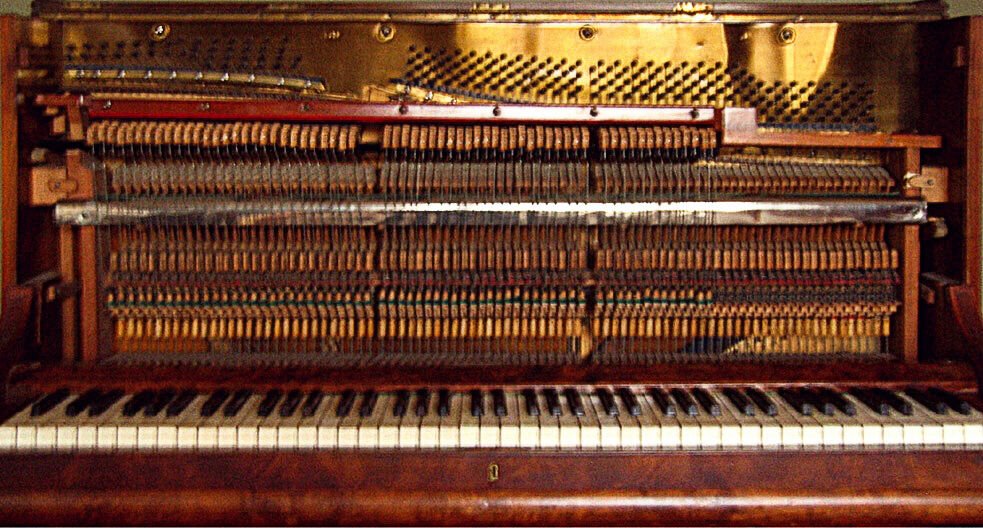
This little gem is an old German upright that lived most of its life in Johannesburg, South Africa. It resembles several old (and not so old!) English uprights that I have seen over the years. The top action has wooden brackets on either end, and the dampers are carried in a damper action called a bird-cage. In a bird-cage action, the dampers are above the hammers rather than below, and the dampers are lifted by long wires that run down and attach to the fronts of the wippens. It is these long parallel wires that give the action its name. (In a modern upright action, the dampers are below the hammerheads and lifted by metal tabs, called spoons, attached to the backs of the wippens, out of sight.)
Unlike the English uprights, this upright has bass strings that cross over the treble strings, as in modern uprights. (The English uprights are usually parallel-strung rather than cross-strung.) As is typical with European pianos, there are only two pedals. Equally typical is the bookmatched burled-walnut veneer. Sadly missing from this piano are its original candelabra, which had been attached to the front panels above and on either side of the music desk.
The easiest way to tune a piano with a bird-cage action is to remove the bird-cage. Take out the screws holding the cage down (usually one at each end) and lift the cage up and out. Check first to make sure the lift wires are not attached to the wippens - usually they just slip out. Of course now you have no dampers, and the strings all ring out. I have found, though, that I get used to this quickly, and can tune without difficulty. On the lower strings I will use my hand to stop the ringing when it gets excessive.
A full portrait of this pretty little piano:

Thursday, December 18, 2008
The End
When I finish a tuning at a customer's home, I usually run through a bunch of major arpeggios up and down the piano. Then I finish off with a big C11 arpeggio. It's just a habit, but it serves a couple of purposes. First, I'm just "tasting" the piano's tone, now that it's in tune. Second, I'm quickly checking octaves to make sure one or more sections haven't shifted during the tuning. Third, I'm signaling to the customer that I'm done.
Sometimes after I close up the piano, the customer, or, more likely, the customer's child, will sit and play a bit. And I don't know why, but the piano always sounds a little out of tune to me, even though when I played it I was satisfied. Maybe it's because the piano sounds different from a different vantage point, or I'm just paranoid about the quality of my unisons. I've learned to not respond to my apparently distorted perception - I listen to and applaud the child, or marvel at the octogenarian ripping off some ragtime, or sit quietly and write out my bill.
But I do love it when I leave the house, and as I get into my car, I can hear my customer in the house, playing up a storm.
Tuesday, December 16, 2008
Irregular Temperament

I'm really enjoying tuning the harpsichord over at the University of Rhode Island for their Bach Ensemble. I don't get to tune a non-equal temperament very often. When I first started work there, I asked them what temperament they would like me to use. I had my Jorgensen in hand, ready to roll! But they were so astonished that I was willing to tune it at all, they just said use whatever temperament you want.
The harpsichord was built by Eric Herz, a well-known builder from Boston. No one in the department seems to know exactly how old it is, and I can't find a serial number (though I found a number in chalk on one of the beams underneath). It was apparently one of Herz's earlier ones. It's a small 'chord, one manual, two ranks, very pretty sounding, nice craftsmanship.
So what temperament did I use? Before I name it, I'll tell you where I got it and how it's tuned. I received a call a few years ago from an instrument maker on the West Coast who was building a clavichord for a customer of mine. Apparently my customer was going to have me tune it, so the builder wanted to speak with me. He explained what temperament he was going to use in the design, and gave me a website where I could find instructions.
The easiest way to describe the temperament is by indicating how the fifths should be tuned, which is appropriate for a well temperament (the comma I'm referring to here is the Pythagorean comma):
F - C, C - G, G - D, D - A, A - E (-1/6 comma)
E - B, B - F#, F# - C# (0 comma)
C# - G#, G# - D#, D# - A# (-1/12 comma)
A# - F (+1/12 comma)
The surprise is that last fifth being stretched.
Here's a quick explanation. In Western music, we insist that 12 fifths laid end-to-end will equal 7 octaves. Nature has other ideas, however, and 12 pure fifths is slightly greater than 7 octaves. The difference is called the comma, and the question is, what do we do with it? In equal temperament, we divide it equally among all 12 fifths by shrinking each fifth the same amount, 1/12 of a comma. Tempered thus, the 12 fifths do indeed equal 7 octaves, and the fact that the fifths are shrunk is hardly noticed, or at least we learn to not notice the effect.
So with this temperament, the first 5 fifths are each shrunk twice what they would be in equal temperament. The next 3 fifths are tuned pure. The next 3 fifths are tuned as they would be for equal temperament. If you add up all the tempering at this point, we have overshot the comma by 1/12, so that last fifth is tuned so that it sounds like an equal tempered fifth, but it's stretched.
Now the 12 fifths line up to equal 7 octaves, but the fifths do not sound all the same, as they do in equal temperament. Nor do the thirds all sound alike, or the sixths, or any other intervals. In fact, each of the 12 keys will sound a little different, will have a slightly different "color." It's key color that is missing from equal temperament.
The most famous proponent of well temperament was Johann Sebastian Bach, who wrote an entire series of pieces using all 12 keys (plus 12 more enharmonic keys) called The Well-Tempered Clavier. So which temperament did he use? No one knows, but at least one person claims that the very temperament I've described here is, in fact, old Bach's.
This is a scholarly hornet's nest I'd rather avoid; go visit the website yourself (link below). I've used this temperament on harpsichords, clavichords, and even a piano, and whether or not it's Bach's, it works very nicely - nice key color, no wolf intervals, works in all keys. It's quick and easy to tune once you get the hang of it.
Related websites:
Bradley Lehman's website on temperaments
The PTG's page on Owen Jorgensen
Monday, December 15, 2008
Every Year
This happens to me every year. As winter approaches, I trade in my light short-sleeved shirts for heavier long-sleeved ones, but with the sleeves rolled up. Then I finally stop rolling up the sleeves. Next thing I know, I'm tuning a piano and as I hit a note with my left hand, I hear an intermittent but unmistakable click. What was that? I try again; no click. Wait, there it is again, what is that? Loose hammerhead? Loose whippen heel?
Duh, it's the button on my shirt cuff hitting against the keytop. I fall for it every year.
Duh, it's the button on my shirt cuff hitting against the keytop. I fall for it every year.
Sunday, December 14, 2008
The Piano Tuner's Song
The Piano Tuner's Song is what my teacher at The New England Conservatory, Frank Hanson, used to call the sound of tuning the temperament. Going around the circle of fifths, checking thirds and sixths, makes for an odd but intriguing ditty.
Years ago I went to a customer's house and settled in to tune their console. A young boy, five or six years old, was quite excited to have me there, and he seated himself on the braided rug behind me and listened attentively. It's not unusual, of course, for children to be curious about what's inside a piano, and I usually let them hit the keys to see the whippens and hammers move. They soon run off to play, and I resume. This boy, however, did not approach the piano to look; he stayed quietly seated as I tuned, and for much longer than I expected.
In time, though, he did rise and walk into the kitchen. "Mom," he cried with exasperation, "I don't know what song he's playing!" It seems, I discovered later, that he thought a piano tuner was someone who came to your house to play tunes for you on the piano.
Brittle Strings
I recently tuned a small Ampico grand, from the late 30's or early 40's I would guess. It had those brittle strings which throw off a lot of high frequencies, making it difficult to tune. I've noticed this before on old Ampico grands, and old Sohmer grands, too. Jewetts are famous for this problem - my heart sinks when I open up a Jewett upright and see all those broken strings in the extreme treble.
The high frequencies tend to cause me to tune the strings a little sharp. Then I struggle to get them back down, a struggle exacerbated by the inevitable rust on the strings and corrosion at the agraffes. When I was done, though, the tuning was fine, but the piano sounded a little harpsichord-ish, except for the tubby bass, all of which is typical.
I've tuned old Chickerings that were older than a century, and I've not had quite the same trouble, even though the strings were plenty brittle. The difference seems to be that on the Chickering, the string tension is much lower. I've also tuned pianos as old as the Ampico but whose strings were not nearly as brittle. The strings that tend toward premature brittleness must be of a different composition. Even the rust on them looks a little different.
Increased brittleness in strings is a natural consequence of age. The strings, which are under constant tension for decades, actually change their molecular structure over time. The atoms creep and shift, relieving some of the stress. This is the string "stretching out," something it does for its whole existence. The string becomes less springy, more brittle, more liable to break, more likely to throw off false beats. The fundamental frequency weakens, making the string sound tinny, and the string's overtones probably become more inharmonic because of the increased stiffness. I think that's what fools my ear when I tune.
A few things to bear in mind when tuning a piano like the little Ampico. Be very careful about raising pitch - you don't need to overshoot A440 much because there's not much stretch left in the strings, and I don't recommend raising more than 100 cents without letting the strings rest. Expect false beats - don't mess too much with unisons, it'll be easier to touch them up later after the strings have rested a little. Finally, you'll notice that the brittleness increases as you move up the piano, perhaps because the strings are thinnner. That's why in a Jewett you'll see all those broken and replaced strings up there.
Related websites:
There does seem to be controversy and confusion about exactly what happens to piano wire under tension over time. There are several ways that strings "stretch out," but the mechanism I'm referring to is creep embrittlement.
See Wikipedia on:
Deformation of materials
Material strength and toughness (including steel)
Dislocation within crystal structures
Subscribe to:
Posts (Atom)